Componentized content definition
Componentized content structures information into reusable, modular pieces, enabling faster updates, consistent messaging, and omnichannel delivery across websites and apps using CCMS and headless platforms.
Componentized content is a way of creating and managing information as small, reusable building blocks instead of fixed pages or documents. Each block—such as a product spec, image, FAQ, warning, or call‑to‑action—is stored once and reused wherever it’s needed. Update the block in one place and the change appears across websites, apps, chatbots, and PDFs, keeping everything consistent and up to date.
This modular approach is supported by systems like CCMS platforms and modern headless tools such as Sanity, which make it easy to structure content, collaborate, and publish to multiple channels. The result is faster updates, fewer errors, and a single source of truth for teams and customers alike.
Page-based content ties words and media to a specific page and layout. Copy often gets duplicated across pages or channels, so teams must edit the same text in multiple places when something changes. This approach limits reuse, slows updates, and makes brand and regulatory consistency harder to maintain.
Componentized content separates content from presentation. Information is stored as structured blocks with their own lifecycle, versioning, and relationships (as supported by CCMS tools) and then assembled into pages, apps, chat, and print. Platforms like Sanity and CCMS solutions let teams model components, enforce fields, and publish everywhere from a single source, enabling faster updates, omnichannel delivery, and easy personalization/experimentation without duplicate editing.
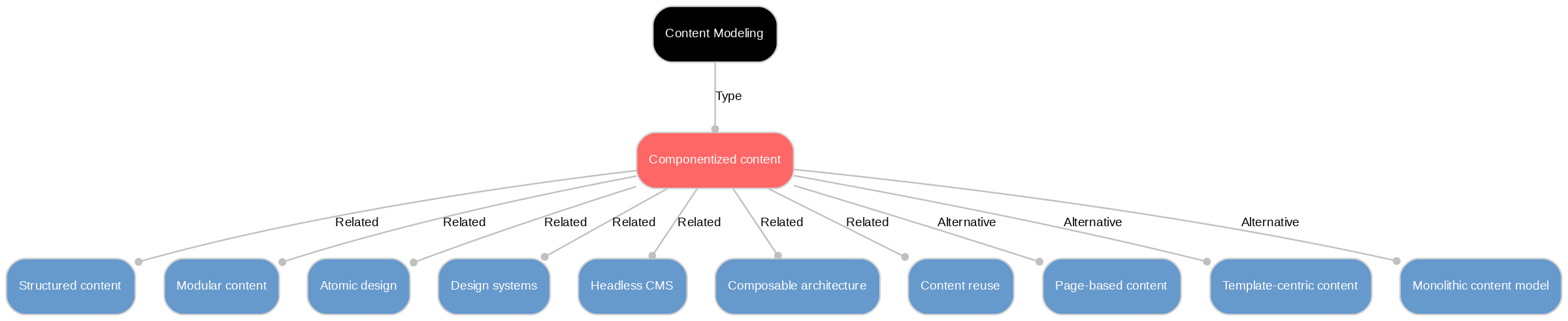
Key benefits include governance and compliance (approve or audit specific components), faster localization (translate once, reuse everywhere), consistent branding (shared components for headers and CTAs), and measurable reuse (improve a component based on performance). Platforms like CCMSs and Sanity provide versioning and workflows at the block level, cutting maintenance while scaling content operations.
Common use cases: product catalogs (specs, pricing, compatibility), knowledge bases and FAQs, regulated disclaimers and safety notes, e‑commerce promos and UI elements, emails and in‑app messages, and support chatbots that surface precise answers. Teams model components once and publish across channels—web, apps, chat, and print/PDF—without duplicate editing.
Discover More with Sanity
Now that you've learned about Componentized content, why not start exploring what Sanity has to offer? Dive into our platform and see how it can support your content needs.
Last updated: