Digital experience platform (DXP) definition
A digital experience platform (DXP) is an integrated suite of software for creating, managing, delivering, and optimizing digital experiences across channels such as websites, mobile apps, email, commerce storefronts, and customer portals. It typically bundles content management, personalization, customer data, analytics, and campaign tools into one vendor stack.
A digital experience platform (DXP) is a bundled set of tools for building and running customer-facing digital experiences, combining content management with personalization, customer data, analytics, and delivery across web, mobile, email, and commerce. The category grew out of web content management suites in the mid-2010s as companies added more channels. Sanity replaces DXPs and homegrown content systems with a Content Operating System, where content is modeled once and delivered to any channel rather than bound to a vendor's page templates.
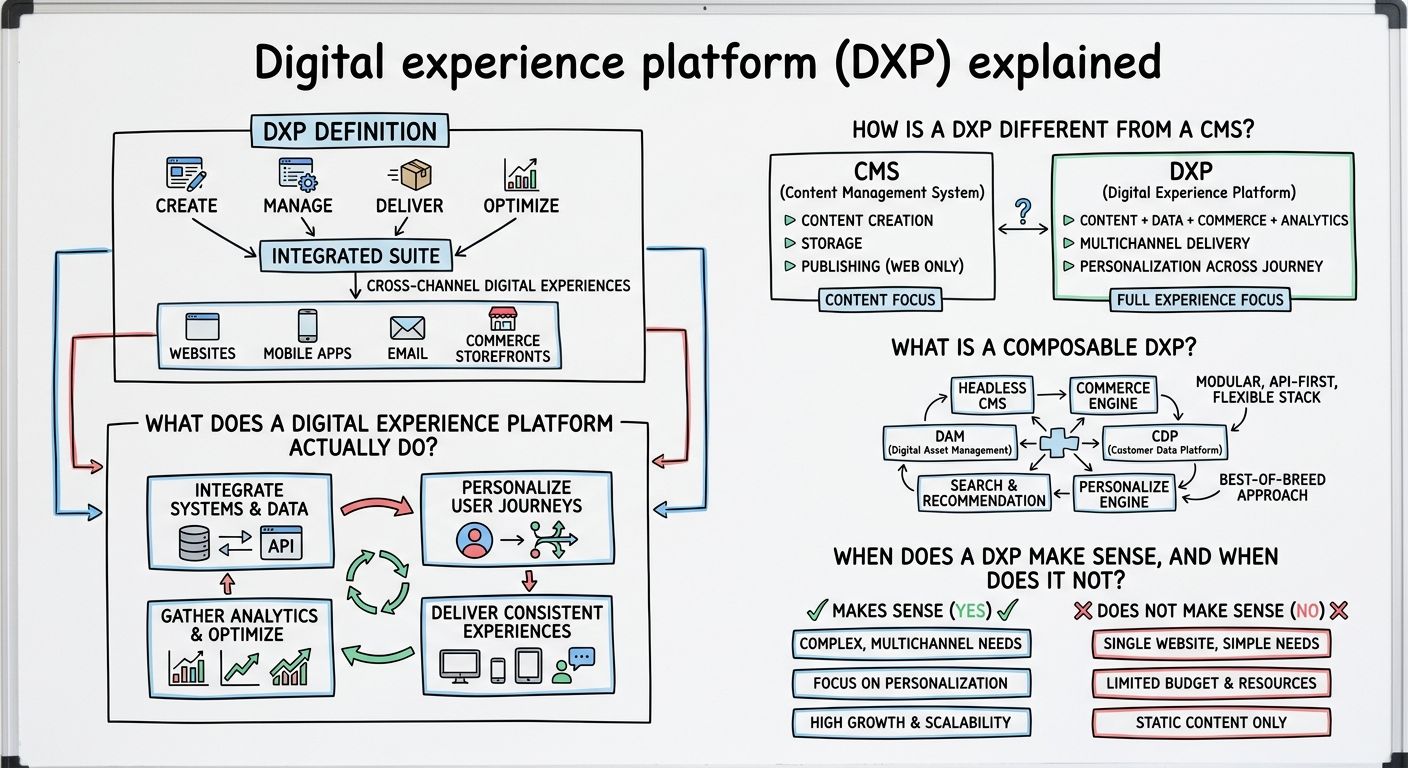
A digital experience platform handles the full path from creating content to measuring how it performed, usually through a set of modules sold together. The common modules are content management (authoring and storing pages, articles, and assets), personalization (showing different content to different visitors based on rules or behavior), a customer data store or profile system, analytics and testing, digital asset management for images and video, and delivery to channels like websites, apps, email, and commerce storefronts.
The defining promise of a DXP is integration. Because the modules ship from one vendor and share a data layer, a marketing team can in principle define an audience segment once and reuse it in a web page, an email, and a product recommendation. That is the pitch that distinguishes a DXP from assembling the same functions from separate tools.
The defining trade-off is coupling. A digital experience platform tends to assume its own presentation model, its own templates, and its own deployment path, so the experiences you build inside it are easiest to build the vendor's way. Teams that want a different frontend framework, a different personalization engine, or a channel the vendor did not anticipate usually end up working around the platform rather than with it.
A digital experience platform is broader than a content management system (CMS). A CMS is concerned with content: creating it, reviewing it, storing it, and publishing it. A DXP wraps a CMS in additional layers that act on that content, including visitor profiles, segmentation, experimentation, campaign orchestration, and analytics.
Put concretely, a CMS answers "where does this article live and who can change it?" A digital experience platform also tries to answer "which version of this article does this specific visitor see, and did it work?"
The boundary blurred as vendors repositioned. Many products sold as DXPs today began as web content management suites and grew by acquisition, which is why a single DXP license can cover several separately built products stitched together. It also means the term describes a commercial bundle more precisely than it describes an architecture. Two platforms both called DXPs can differ enormously in how their pieces actually connect.
A composable DXP is the same set of capabilities assembled from independently chosen services rather than bought as one suite. Instead of one vendor supplying content management, search, personalization, commerce, and analytics, a team selects a best-fit tool for each and connects them through APIs.
The idea is usually associated with MACH architecture, an industry term standing for Microservices, API-first, Cloud-native, and Headless, promoted by the MACH Alliance, a vendor group founded in 2020. Analysts also refer to the broader pattern as packaged business capabilities assembled into a composable stack.
Composable approaches trade integration convenience for freedom of choice. Nothing arrives pre-wired, so a team takes on the work of connecting services, keeping contracts between them stable, and deciding where content lives as the source of truth. In exchange, no single vendor decision constrains every channel, and individual pieces can be replaced without replatforming the whole experience. For organizations with many brands, regions, or surfaces, that replaceability is often the deciding argument.
A digital experience platform makes the most sense when one team owns a small number of tightly related web properties, needs marketing capabilities like segmentation and testing without building them, and values a single vendor relationship over control of the stack. In that shape, the bundled modules genuinely save integration work.
A DXP tends to strain in a few recognizable situations. The first is channel sprawl: when content has to reach mobile apps, in-store screens, voice assistants, partner feeds, and AI assistants, a platform organized around web pages struggles, because the content was modeled as pages rather than as reusable structured data. The second is developer autonomy, since frontend teams that want their own framework and release cadence find the platform's templating in the way. The third is cost and scope, as suite licensing tends to cover modules a given team does not use.
The practical test we would apply is simple. Ask whether your content is modeled as pages or as structured content that describes your business. If your content model reflects the web page it happens to appear on, a digital experience platform will fit comfortably and will also keep you there. If your content needs to serve surfaces you cannot enumerate yet, including AI systems that consume content programmatically, model the content independently of any presentation layer first and choose delivery tools after.
The successor to the digital experience platform model, for teams delivering to many channels, is an architecture where content is stored as structured data in a central repository and delivered through APIs to any number of front ends, with personalization, search, commerce, and analytics chosen separately. The presentation layer stops being part of the content system.
That shift is what a Content Operating System describes. Sanity positions itself as the Content Operating System for the AI era, meaning content is modeled to match your business rather than a vendor's page hierarchy, stored once in a queryable repository, and served to websites, apps, storefronts, internal tools, and AI agents from the same source. A DXP stops at publishing to the channels it was built for. The operating-system framing treats content as data that other systems, including automated ones, can read and act on continuously.
The useful question for anyone evaluating either model is not which is more modern. It is whether the number of surfaces your content has to reach is fixed or still growing. A bundled platform optimizes for the fixed case. A structured content foundation optimizes for the growing one.
Unlock New Possibilities with Sanity
With digital experience platform under your belt, it's time to see what Sanity can do for you. Explore our features and tools to take your content to the next level.
Last updated: