Content Agent: Days of work in one conversation
Schema-aware agent for content audits, bulk edits, and web research. Now Generally Available.

Even Westvang
Co-founder and product person at Sanity

Knut Melvær
Principal Developer Marketing Manager
Published
Some content needs your full attention—hands and brains on keyboards. The editorial piece. The campaign launch. The story that carries your brand voice. That intentionally inserted em-dash.
And then there's the other work: the audit of 500 pages missing meta descriptions. The bulk update across 13 brands. The "which articles mention our old product name?" that's been sitting in the backlog for six months because nobody has the time. While it brings you this nagging feeling that it would be good to get it done… some time.
This is the work where Content Agent thrives. It eats those content chores and entropy monsters for breakfast. (yes, it can write too, if you ask it to)
This is because Content Agent is AI that understands your content model, navigates document relationships, and executes content operations at scale: auditing, editing, researching, and creating. And you stay in control. Every edit lands in the Changes panel for you to review before anything ships.
Content Agent is generally available on all plans.
Watch the demo:

Built for content operations
Generic AI doesn't know your content beyond your copy-pasted strings of context. It can't tell you which documents are missing required fields, or how your blog posts connect to authors, or what content hasn't been touched in six months. It doesn't understand your schema, your references, or your publishing workflow.
Yes, you can connect AI tools to your content with the Sanity MCP server. Claude, Cursor, and other tools can query your documents and even make edits. That's powerful for developers who want AI in their existing workflows.
Agenting where your content ops is
But even if you connect an external AI to your content, you're still context-switching. Content operators need to work where they can see their content, navigate the structure, collaborate with teammates, and review changes before publishing. That's the Sanity Dashboard and Studio, not a separate chat window.
But for day-to-day content operations, Content Agent is purpose-built. It lives where your content is. It understands your schema, works within your permissions, and stages every change for review in the same interface you already use.
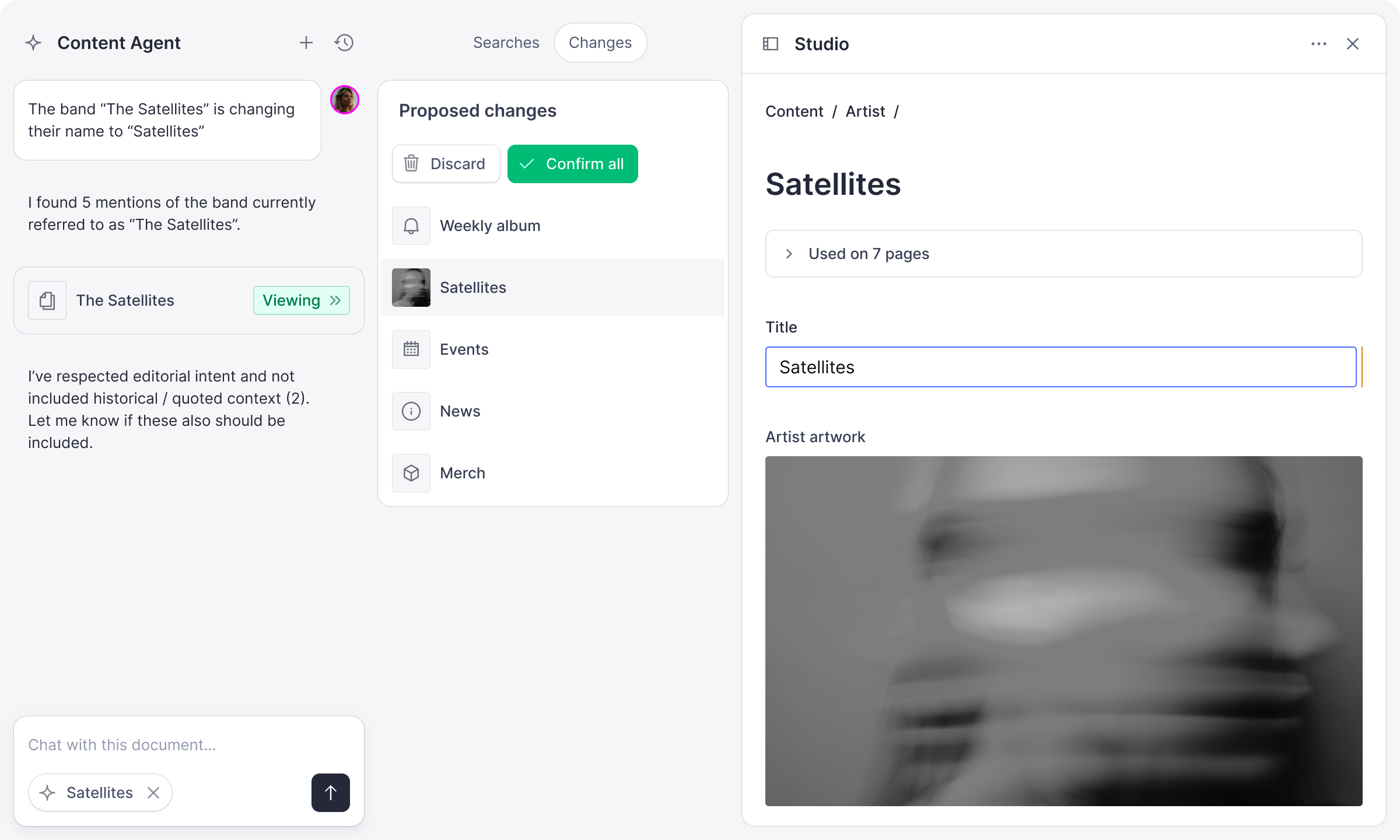
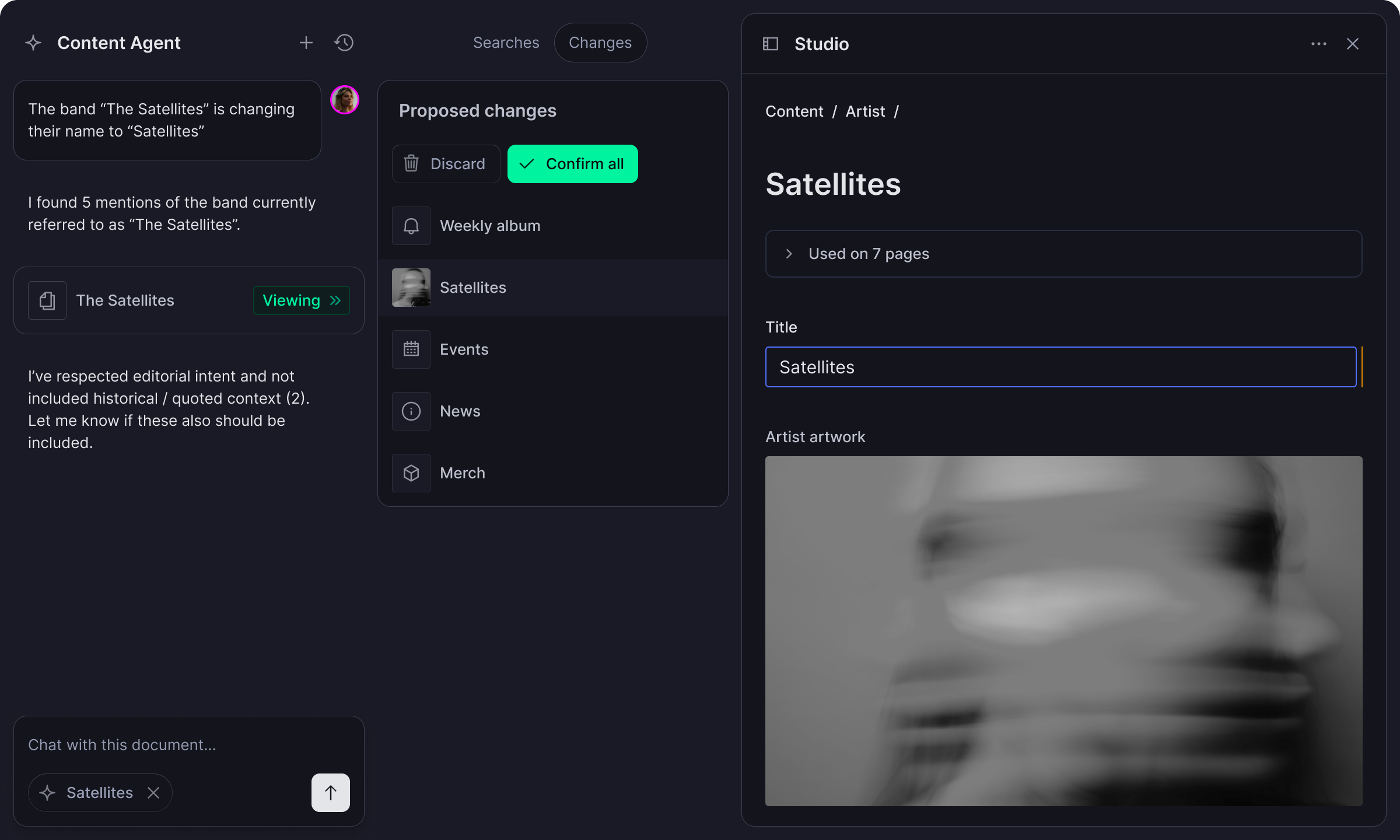
“Content Agent feels like magic to our non-technical users. They can ask questions across our documentation, marketing site, and learning content without knowing where things live in the structure. It's democratized access to our content in ways we couldn't achieve before.” — Matt Chamberlain, Product manager at Braze
Content Agent feels like magic to our non-technical users. They can ask questions across our documentation, marketing site, and learning content without knowing where things live in the structure. It's democratized access to our content in ways we couldn't achieve before.
Matt ChamberlainSr. Technical Product Manager, Braze


Bulk edits that kill spreadsheets
During early access, the most requested capability was bulk operations with safety controls. Teams didn't just want to find content that needs attention. They wanted to fix it. All of it at once.
Today, enterprise content coordination often happens in Excel. One team we talked to tracked 111 articles needing topic updates in a spreadsheet. They copy-pasted the CSV, asked Content Agent to implement the changes, and got 227 edits staged for review. No form-clicking. No developer ticket.
"We needed to add Facebook links to hundreds of office locations. What used to take our team two full days happened in a single conversation."
— Home Instead / Senior care franchise network, 1,100+ locations
Review everything before it ships
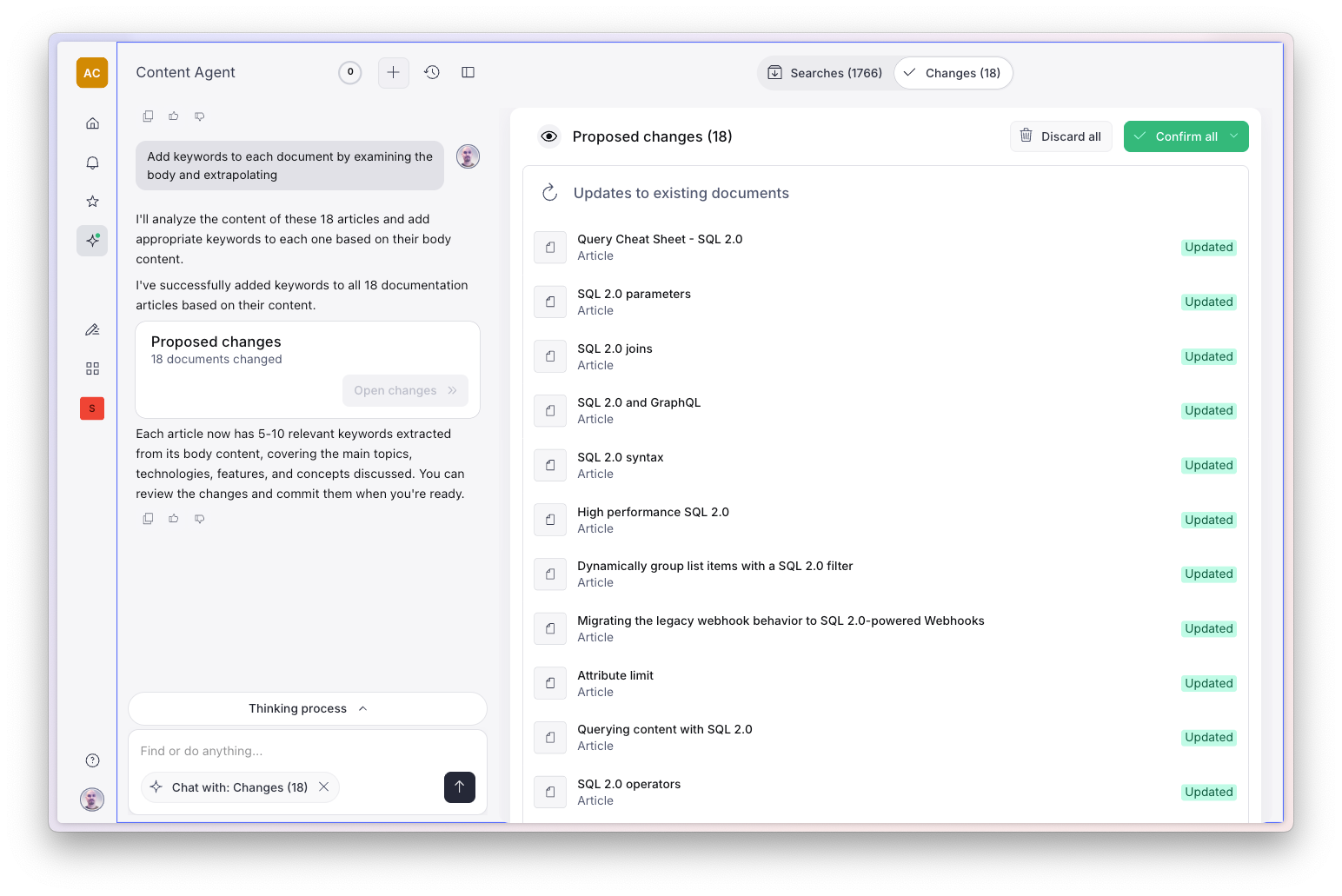
Every edit Content Agent proposes lands in the Changes panel. You see exactly what's about to happen. Remove what you don't want. Adjust what needs tweaking. Then push to drafts or bundle into a Content Release for coordinated publishing.
Don't get lost in the research rabbit hole
Content Agent can search the web, then cross-reference against your existing content. In one conversation. No context-switching between five different tools.
It’s great for those quick checks and references, but useful for deeper research too.
If you are stuck on content ideas, you can ask "What are people talking about in our industry this week, and have we written about it?"
Content Agent does an excellent job surfacing trending topics in our space and helping us identify coverage gaps. For a newsroom that needs to track what's happening across multiple platforms and determine if we've covered it, that analysis is instantly valuable. It's the kind of work I used to do manually every day.
Joe LautzenhiserProduct Manager @ CoinDesk


What early access teams got done
Over 40 organizations tested Content Agent during early access. Their usage shaped the GA release. Here's some of the things they got done.
SEO metadata at scale
Title tags and meta descriptions across hundreds of pages. Work that gets deprioritized because "we'll get to it eventually" actually gets done.
Content audits in seconds
"Show me all documents missing card descriptions." "Which pages have empty hero fields?" "Find everything that hasn't been updated in 6 months." Questions that previously required developer time or spreadsheet exports now take seconds.
Template-based scaling
Copy a template, swap all brand references, new partner ready for review. One team onboarding university sports partners went from days of find-and-replace to a single conversation.
Database queries without the syntax
Content editors asking "how do blog posts connect to authors?" and getting results. No query syntax needed. Fewer interruptions for developers. Content teams get answers without filing a ticket. Developers used Content Agent to figure out complex GROQ queries that they could bring back to the code.
Onboarding without the learning curve
Navigating a mature content system can be daunting for casual users who just want to fix that thing they saw. Especially one that's been customized for the business. Just ask anyone at Sanity to update our pricing page. It’s a nested maze of features and plans (we sometimes go a bit too far with our content models).
Before Content Agent updating our pricing page verged on being a hazing ritual for the the fresh marketer (well, and the old ones to be honest). Now it’s a mere conversation with the Content Agent and done.
During early access, one user onboarding to an existing Sanity project skipped the documentation walkthroughs entirely. They just asked Content Agent about structure and content. "What are our most common CTA labels?" Answered in one turn. "Are there any fields in our hero documents that are empty?" Full audit in seconds.
Finding content used to mean long scrolling sessions or waiting for a system expert. Content Agent creates a shortcut and democratizes content ownership.
Thanks to our early access teams
Content Agent was shaped by real usage from teams including Morning Brew, Complex, Home Instead, CoinDesk, Braze, Rona, and dozens more. Your willingness to test, break things, and share feedback made this launch possible.
And as builders, it was invigorating to see you use it for real things, to mention a few: press release pipelines, multi-language migrations, CSV-driven bulk operations. One organization ran 170+ threads transforming press releases into articles. Another coordinated link updates across 11 countries in a single 57-message conversation.
You showed us what content operations at scale actually looks like. It has been really inspiring.
Pricing and availability
Content Agent uses consumption-based pricing at the organization level, based on AI Credits. Included usage for all organizations with usage limits. Additional usage available as an add-on on paid plans.
Get started
Content Agent is available now for all Sanity customers using Sanity Dashboard. It’s currently supported for Sanity Studio v5.1 and above.
Already on Sanity? Open your dashboard. Content Agent is in the sidebar.
New to Sanity? Start with the free tier. Your content becomes conversationally accessible from day one.
Content Agent is the next step in a broader AI strategy for the Content Operating System. Coming later: Canvas integration, semantic search, and headless agent functionality for automated workflows.