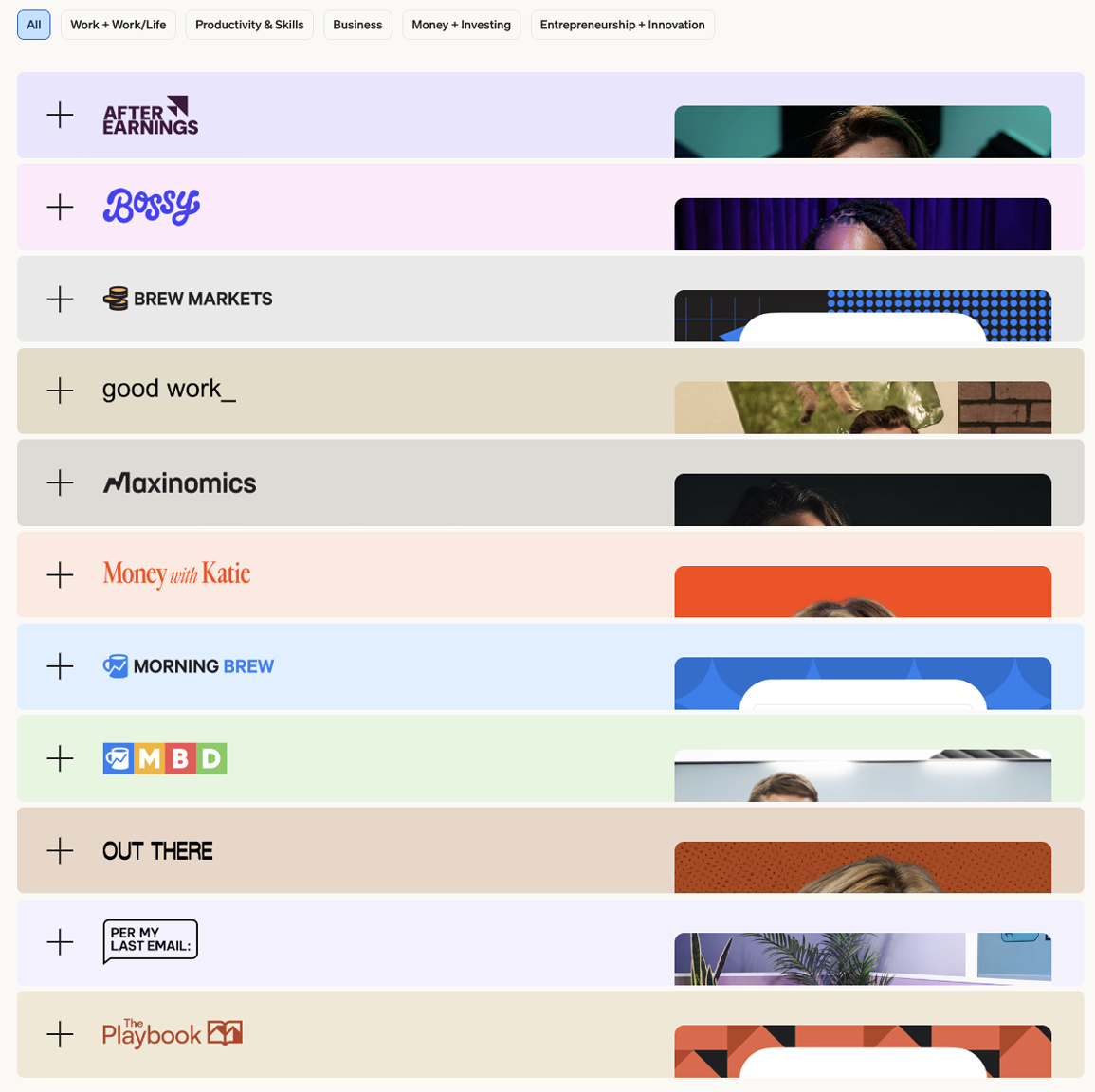

As Morning Brew scaled from a single newsletter into a full-fledged media company, the limits of traditional content systems became clear. Their homegrown setup, like most CMSes, was built for publishing, not for operating content at scale. It lacked the structure, developer tooling, and flexibility needed to support modern editorial workflows, automated content operations, and content reuse. It wasn’t built for the speed or complexity of a high-growth media business.
Teams spent too much time coordinating across tools, rewriting, copying content, and chasing approvals manually. Adding a new content type or brand meant weeks of engineering time. Editorial and ad teams worked in silos, leading to friction, rework, and constant handoffs.
Key challenges for Morning Brew’s teams:
Each new format, whether a newsletter, ad unit, or editorial block, had to be built as a one-off with no shared structure or reusable components. It was hard to scale, and engineering time was spent recreating patterns instead of extending a system.
Editorial and ad operations for daily newsletters relied on email chains, spreadsheets, and Slack messages. They had no way to automate the repetitive work.
As the company expanded to multiple brands and distribution channels, duplicated content and one-off workflows created technical debt.
Developers were spending time on maintenance tasks and editorial copy-paste jobs, rather than delivering new capabilities.
Editorial, marketing, and partnerships each had their own tools and data models. There was no single source of truth for stories, promotions, or partner content.
You solve problems with people or with technology. We could’ve thrown more headcount at it, but that wouldn’t scale. We needed a system that could coordinate how we build content across teams and brands.
Nick WoodwardDirector of Engineering, Morning Brew

To scale content operations across 13 brands and support multiple editorial and ad workflows, Morning Brew rebuilt its infrastructure around Sanity’s Content Operating System:
- Sanity for structured content management, automation, and editorial tooling
- Content Lake as the single source of truth for all brand, story, and ad data
- Three tailored Sanity Studios:
- Partner Desk for external advertisers to submit structured content for sponsored placements.
- Meteor for internal ad operations to manage partner campaigns, approvals, and delivery.
- Astra for editorial teams to create, preview, and publish newsletters, stories, and web content.
- GROQ and Sanity Client for querying and scripting custom dashboards
- Webhooks and Functions for automation and notification workflows
- Next.js for frontend delivery and server-side rendering
- Vercel for deployment and edge revalidation
- Sailthru as the email send provider, integrated via custom publish actions
- Google Docs integration for collaborative ad briefs
- Yahoo Finance for real-time market data in newsletters
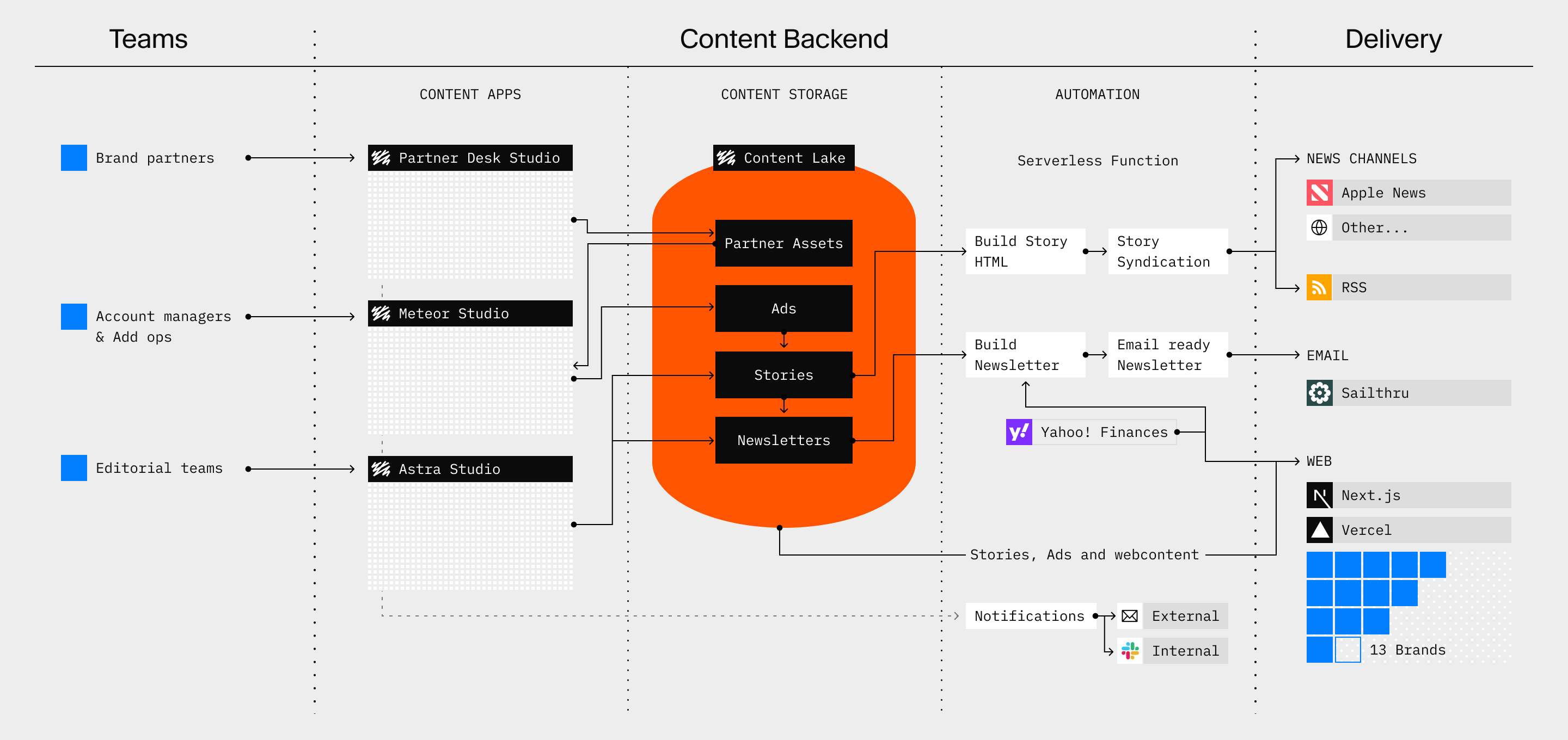
By making Sanity the core of their architecture, Morning Brew unified fragmented content systems into a single platform built on the Sanity Content Operating System. Developers now ship new features three times faster, and Morning Brew can launch new brands in days instead of weeks. Editors create and preview newsletters in real time. Ad operations trigger downstream content events automatically. And the entire organization works from the Content Lake as a single source of truth for all content.
We built separate Studios for editorial and ad workflows, but both run on the same Content Lake. That shared structure is what lets us move fast across teams and brands.
Nick WoodwardDirector of Engineering, Morning Brew
What once required manual coordination across tools is now powered by a single system that enables developers to ship faster and editors to publish independently. Sanity gave Morning Brew the structure, flexibility, and automation to support fast-moving editorial and ad teams across 13 brands, all with just six engineers.
Sanity has given us a clean slate and the opportunity to have our content platform match how the entire organization is thinking about content.
Emily DiamondSVP, Product

Engineers now focus on high-value work and innovation. Editors and marketers work independently inside tools built for how they actually work, publishing faster without looping in engineers. Ad operations are automated. Campaigns go live without handoffs.
The result: accelerated development of new kinds of content, faster brand launches, and a content engine that multiplies impact with a lean team.
Before Sanity, even small content changes required engineering involvement. Now, schema updates, new content types, and workflow changes are handled in code and deployed in hours, not sprints.
Sanity is a huge part of our ability to create enormous value with an incredibly lean team.
Nick WoodwardDirector of Engineering, Morning Brew
- 6 engineers now support the entire content platform for 13 brands
- Studio is fully version-controlled and treated like an app, with React-based custom components, role-specific views, and internal tooling
- Schema-as-code gives developers flexibility and speed, making it easy to evolve content models and ship changes fast.
- Engineers use the Sanity JavaScript Client and GROQ to build data migrations, internal APIs, and admin dashboards
- Webhooks and Sanity Functions drive automation of newsletter creation, ad approvals, and Slack notifications
- Engineers replaced brittle content scripts with durable schema-driven logic, including validation rules, cross-field dependencies, and dynamic inputs
- React-based preview components are embedded directly in Studio, so editors can see exactly how content renders before publishing.
Sanity’s structured approach enabled Morning Brew to consolidate fragmented workflows across teams. They now operate in two purpose-built Studios: Astra for editorial, and Meteor for advertising and partner operations. Both run on the same Content Lake, allowing content to flow seamlessly between teams while maintaining a shared source of truth.
Built by Morning Brew’s engineering team, each Studio is a tailored content app aligned to the workflows of a specific team and powered by the Sanity Content Operating System.
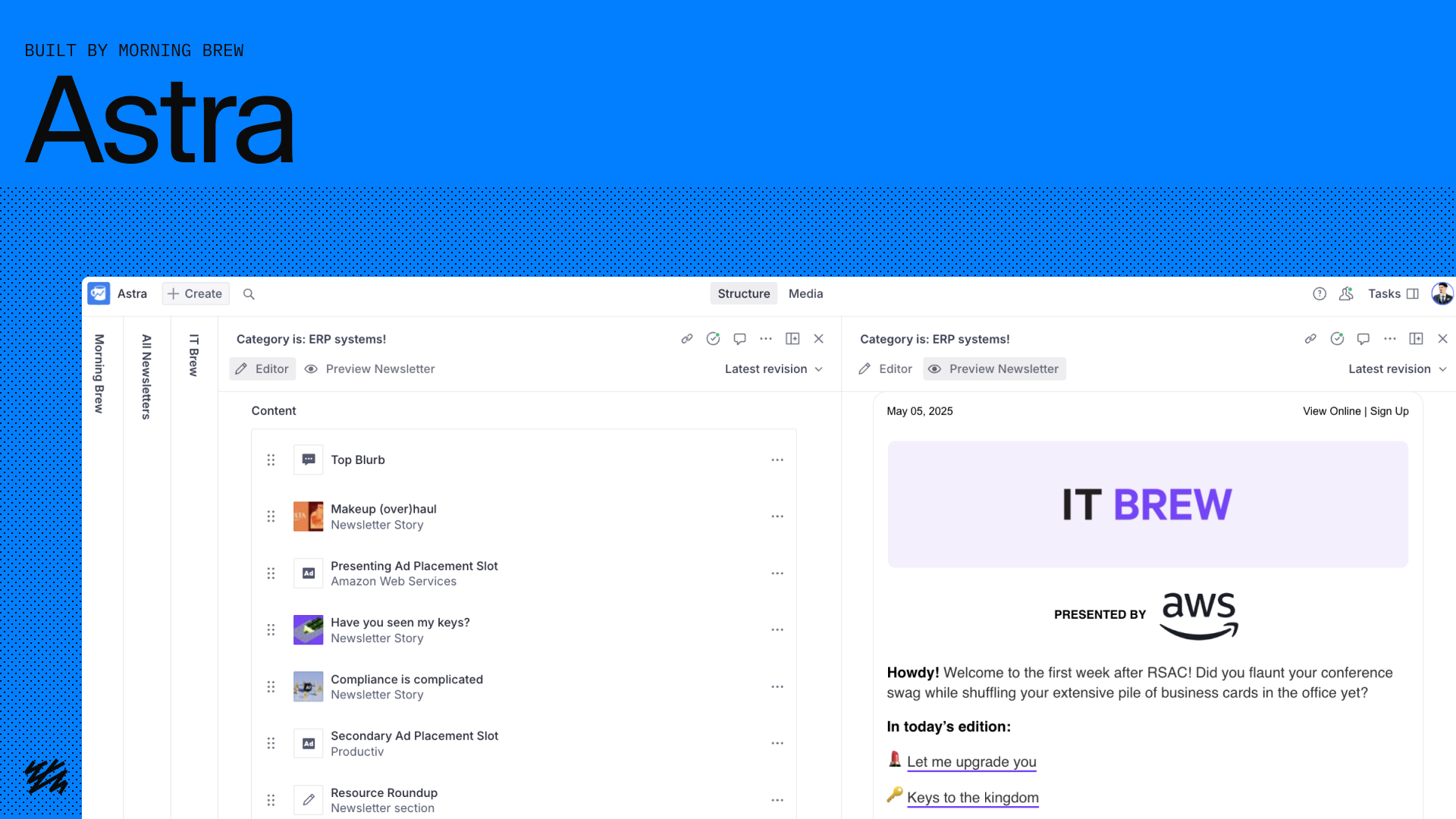
Built by Morning Brew’s engineering team, Astra is the editorial workspace used to plan, write, and preview daily newsletters and stories. The structure defines modular story elements, while editors can preview the complete layout before publishing, without needing to involve engineers.
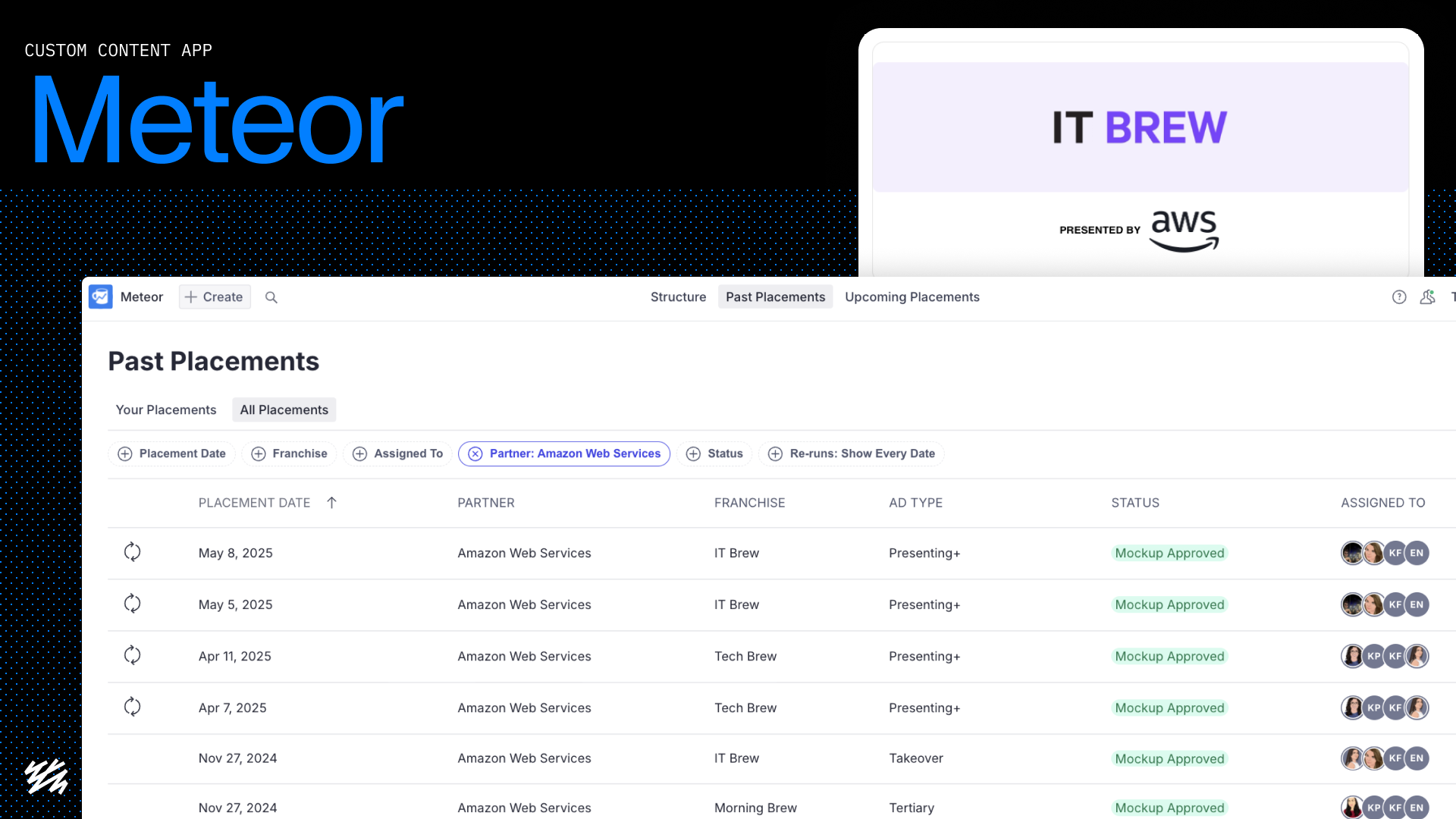
Meteor is the internal dashboard for ad operations. Partner campaigns, placements, approval flows, and deadlines are managed here. Mapped directly to newsletters and tracked across brands.
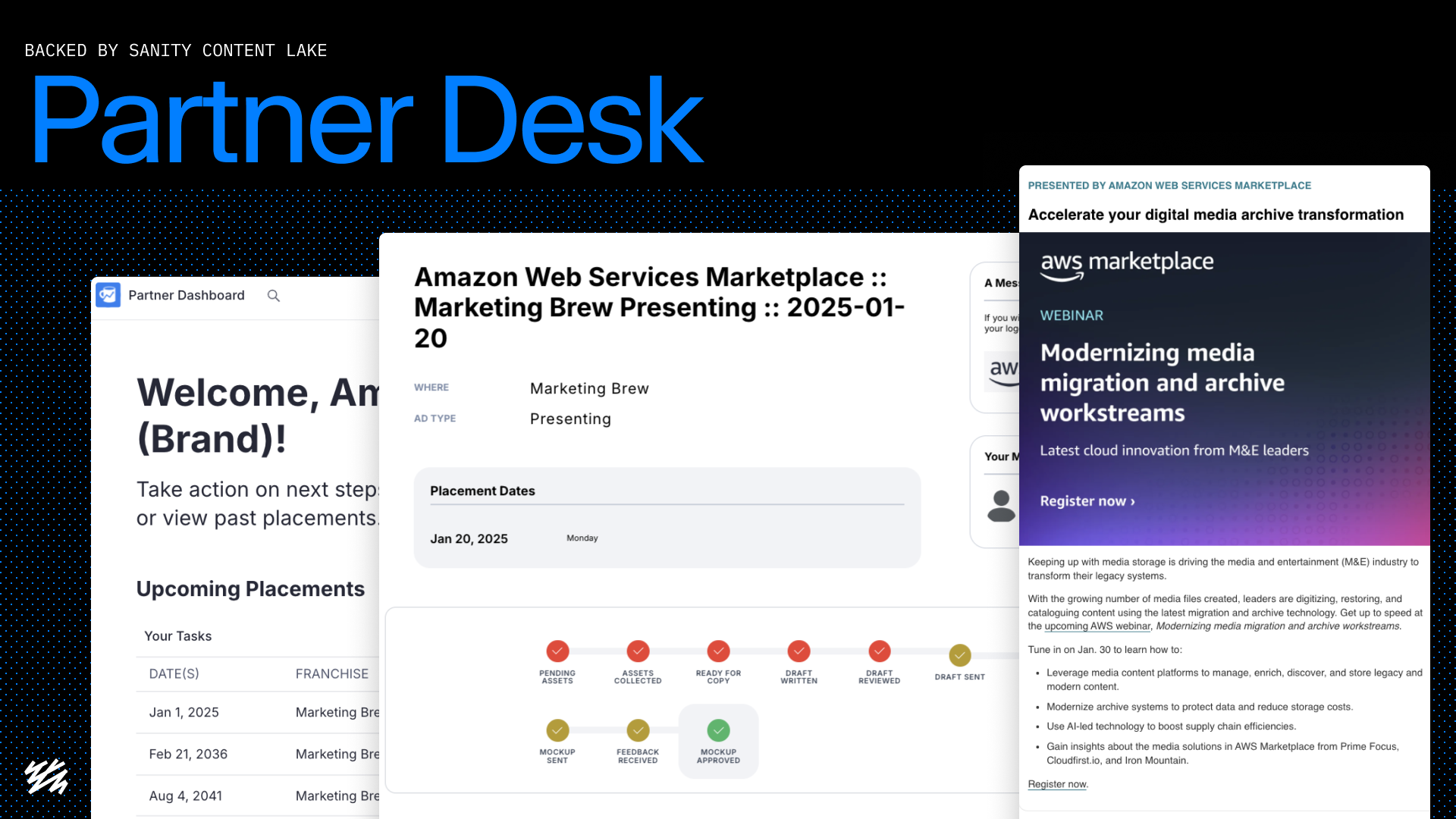
Advertisers get their own structured workspace to upload assets, provide placement details, and track progress through every stage. From draft to approval to publish. This removes friction from creative handoffs and improves time to launch.
See it in action
Step into Morning Brew’s Studios in this behind-the-scenes demo and see how they’ve streamlined publishing across 13 brands using Sanity.
Highlights:
- Separate Studios run in parallel on the same Content Lake: Astra for editorial and Meteor for ads
- Each Studio has a customized dashboard experience tailored to its user role, including partner management, creative briefs, and due date tracking
- Ad content automatically triggers the creation of a “newsletter shell” and routes approvals via integrated notifications
- Editors preview newsletters in real time with a custom-built render component linked to Sailthru
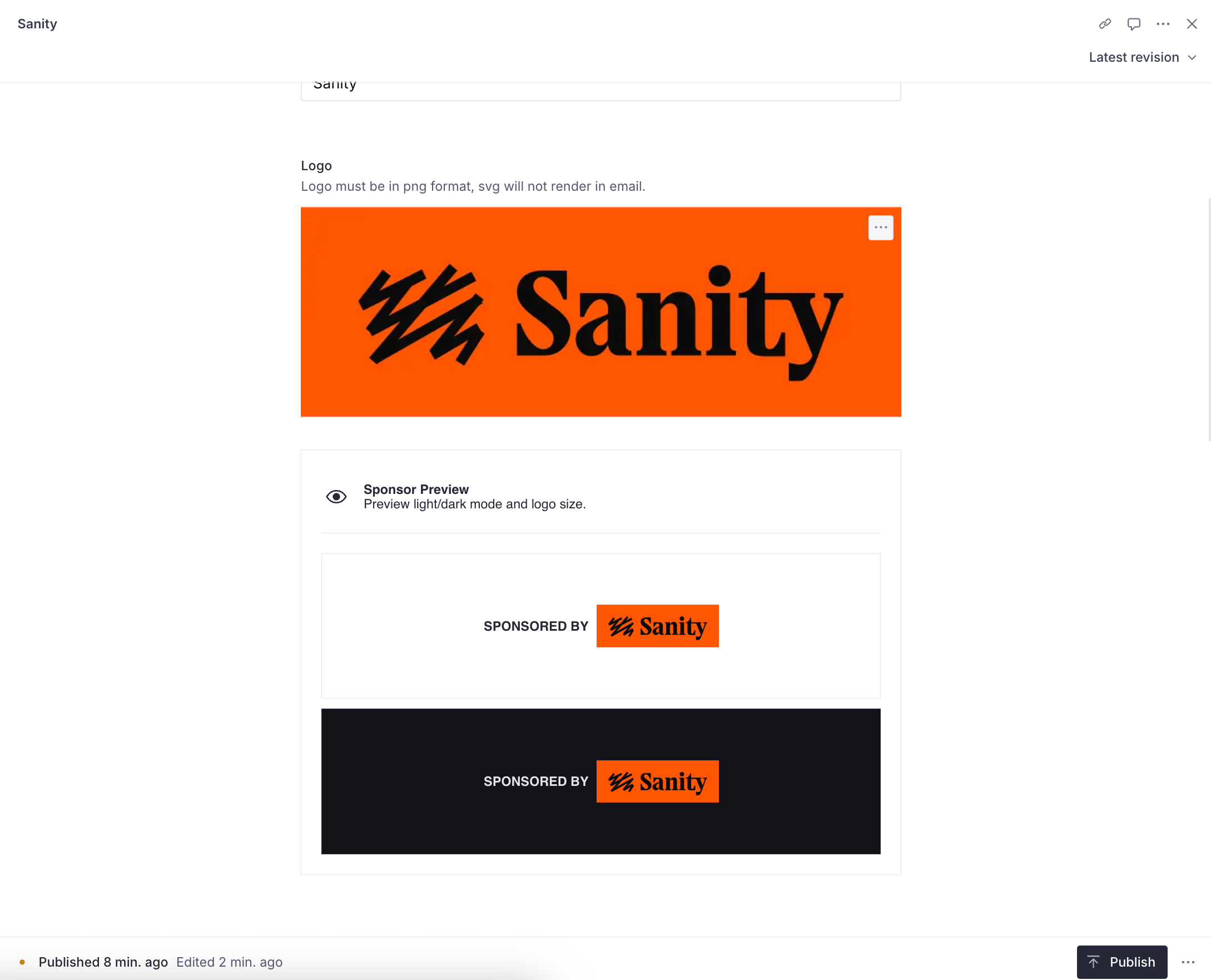
- The content model supports structured inputs like logo aspect-ratio sliders, brand-safe dark mode checks, and partner KPIs. All managed without engineering help.
- Marketers use modular page-building components to create and publish landing pages without waiting on devs.
We’ve built a pipeline for email publishing so that we can create and curate newsletters in Sanity, then send them right from Sanity to our email service provider Sailthru. It’s great that Sanity is helping us make that a one-stop-shop.
Emily DiamondSVP, Product
Before Sanity, content workflows relied on Slack pings, email chains, all manual coordination. Developers wrote one-off scripts to bridge gaps. With Sanity’s structured content and webhook-driven architecture (soon to be replaced by serverless Sanity Functions), automation is now a core part of Morning Brew’s operations.
Webhooks turned out to be a sneaky big unlock for us. They let us automate manual tasks and trigger workflows. Functions take that even further with version control, better logging, and scheduled execution. It gives us everything we need to manage our operations cleanly in code.
Nick WoodwardDirector of Engineering, Morning Brew
- Ads automatically generate newsletter drafts, schedule content, and notify stakeholders via Slack
- Sanity’s JavaScript client and GROQ power internal dashboards for copy editors and campaign managers
- Manual QA steps like partner logo sizing were replaced with embedded tools inside Studio
- Teams are now exploring Functions to codify publishing rules, run updates on schedules, and replace webhook infrastructure with Git-controlled logic
With Sanity at the core, Morning Brew launches new brands and products faster, reuses content across channels, and avoids duplicating work across tools.
We proved it ten times over. We launched new brands and products, and the platform supported them instantly. The speed and confidence we have now is a real competitive advantage.
Nick WoodwardDirector of Engineering, Morning Brew
- New brands can be launched in under a week
- Partner content, creative, and metadata are reused across newsletters, websites, and events
- Editors and marketers work independently without engineering bottlenecks
- Embedded tools like logo size sliders and dark mode previews reduce support load on engineers
Morning Brew transformed its content operations by moving from a brittle, homegrown system to a structured platform built for scale. With Sanity, the team eliminated bottlenecks, automated manual tasks, and created a foundation that supports rapid iteration across editorial, marketing, and ad operations. All without expanding the engineering team.
For developers: Sanity’s developer first approach with schema-as-code, GROQ querying, Content Lake, Automation and APIs gave engineers full control over content structures, editorial interfaces and workflows. They can ship faster, avoid brittle workarounds, and maintain flexibility as requirements evolve.
For content teams: Custom Studios and content apps, real-time previews, and embedded tools let editors manage newsletters, campaigns, and landing pages without relying on developers. Content moves faster, with fewer blockers.
For product owners: Sanity gave Morning Brew the foundation to launch faster, support more brands, and reduce operational overhead, with a lean and empowered team. Structured content and repeatable workflows made it easier to scale with confidence.
With the Sanity Content Operating System, Morning Brew built a platform for long-term scale. It’s flexible, fast, and aligned with how their teams work.
Break up (with) your CMS
Morning Brew did. Their custom content apps let teams move faster, scale smarter, and stay in sync. Built on the Sanity Content Operating System with the Content Lake as the single source of truth.
With Sanity’s App SDK, you can build editorial, ad ops, or partner-facing apps tailored to how your team works. Skip the rigid CMS panels. Build the system your content teams actually need.